Back to Blog

Purim - not quite the story you thought it was

Or "The Iranian People are Not our Enemy"

3 March 2026 / י״ד אדר תשפו / 14 Adar 5786

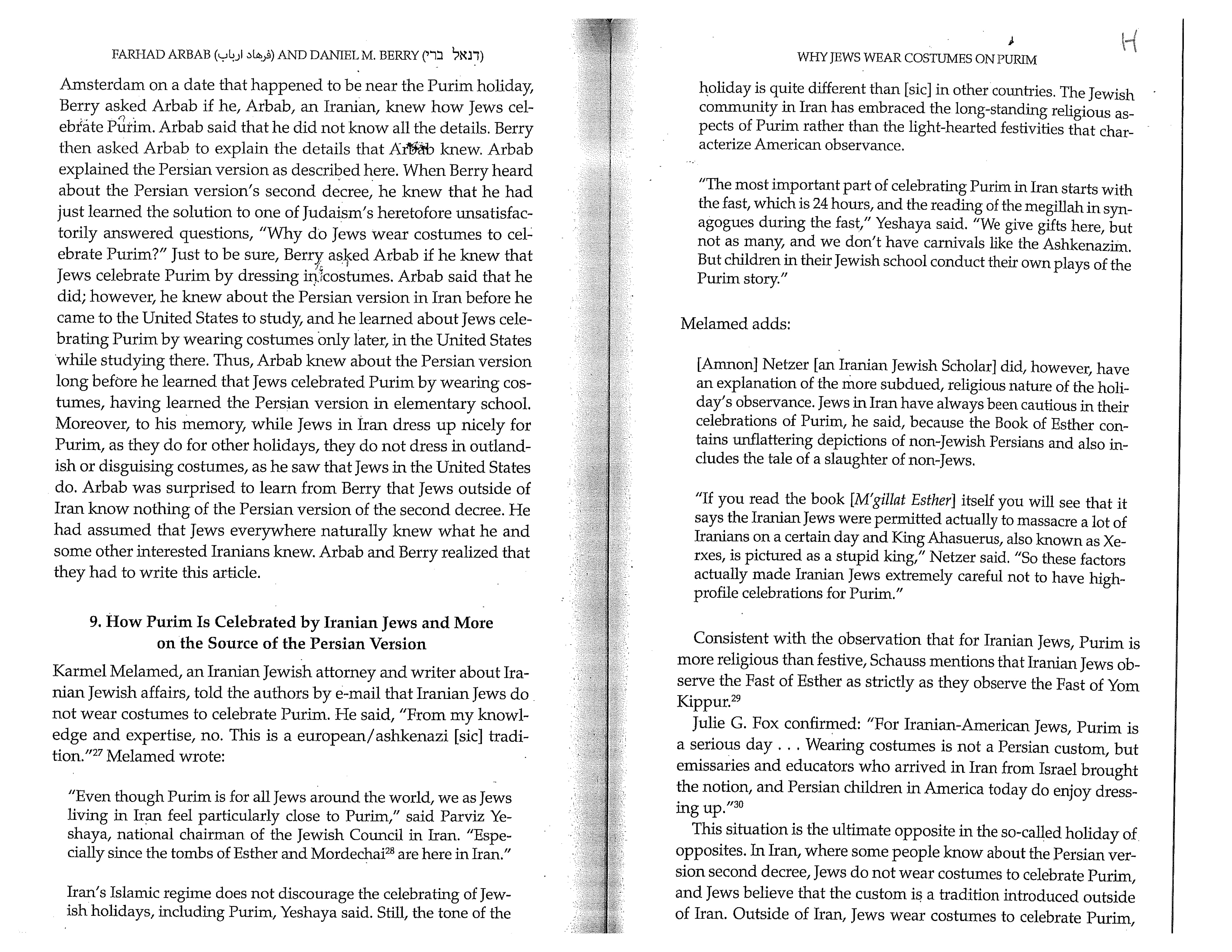
An American-Israeli computer professor visits his friend the Iranian computer professor in Amsterdam, and they get to talking about Purim. The Jewish friend learns that there is a Persian folktale of the story that's been passed down by word of mouth for hundreds of generations.  Same cast of characters, but a radically different ending than the book of Esther. The Iranian friend is surprised to learn that the version he takes for granted is unknown outside of Iran.  So they write a paper together...

I present it here as an antidote to the fear and hatred underlying the US and Israeli and Iranian and Hezbollah bombs and drones and missiles raining down on each other this very moment, in this scary war-that-is-not-officially-declared-a-war. We are not doomed to be enemies.

Scroll down to read the original paper published in the CCAR Journal, Spring 2012, by Farhad Arbab and Daniel M. Berry, in all of its delightful detail, or to download the pdf.

Meanwhile, here's the essence of the difference between the stories:

  • In the megillah of Esther, Haman conscripts the entire populace to massacre the Jews on the 13th of Adar. Mordechai, in the King's name, formally gives the Jews permission to fight back, which probably restrains some of the would-be attackers. In the ensuing battles, the Jews kill thousands of ethnic Persians.  They don't loot, as the text points out twice.
  • In the Persian tale, Haman plans to use his own henchmen to massacre the Jews on the 13th day of the Persian month of Farvardin. (Why would the Persian government use the Jewish calendar anyway?) Farvardin is the month of the Persian New Year, beginning with the holiday of Nowruz. In the year 474 BCE (using the megillah's dating of events to the twelfth year of King Achash-veyrosh's/Xerxes's reign), this date provided Haman a rare opportunity (see sections 6.1 and 7) to attack the Jews on a Shabbat which coincided with the Persian holiday of Sizdeh Bedar (section 5). Since Sizdeh Bedar was -- and is -- a day of dressing up in one's finest clothes and picnicking in nature near a river, this would neatly separate the stay-at-home-on-Shabbat Jews from the picnicking-in-the-country ethnic Persians. It also meant that the Persians wouldn't be around to witness the massacre of their neighbors.  They would return home after a joyous day of picnicking to discover their neighbors dead.
    • SO, in this version, Mordechai issued a decree that Jews should dress as Persians and join the festivities of Sizdeh Bedar. I like to imagine the Jews borrowing  Persian clothing from their neighbors and sharing the celebrations. Thus when Haman's henchmen showed up, there were no Jews to be found! And no bloodshed against anybody.

Haman's use of his own troops suggests that inviting the Persian populace to attack their Jewish neighbors wouldn't have resulted in the the bloodbath that he wanted. The fact that the Persians didn't inform on the Jews picnicking in their midst further reinforces the presence of good relations between ethnic Persians and Jewish Persians. Not only were Jews  on good terms with their neighbors and well integrated into Persian culture, they were valued and protected by their real-life non-Jewish neighbors and friends.

May it be the will of the Holy Blessed One that we see one another as potential friends rather than as potential enemies.

Photo credits: Rabbi Debora S. Gordon, 2010, West Bank
Central panel from American Friends of the Parents Circle - Families Forum

"Why Jews Wear Costumes on Purim,"
Farhad Arbab and Daniel M. Berry, in the CCAR Journal, Spring 2012

Or download the pdf here.

Support

Help sustain our transformative, welcoming spiritual community.

167 Third Street
Troy, NY
12180

Congregation Berith Sholom is a 501(c) (3) organization and tzedakah (contributions) are tax-deductible. Our tax ID number is 14-6014559.